Many people are waiting to feel certain before they change jobs, start the business, move cities or end something that no longer fits. They expect that one day the whole route will be visible, and then they will begin.
That day rarely comes. Clarity mostly comes from action. You earn it by moving, and the path shows itself in pieces that only appear once you are already walking.
This is uncomfortable, because it means acting without a full map. It is also a relief. You do not need to solve your whole life this afternoon. You need to see far enough to take one step.
Planning has real value, but it can turn into a place to hide. You research one more option, ask one more friend and build one more spreadsheet. Each of these feels responsible. Together they can keep you in the same place for years.
A complete plan assumes you already know what you will learn along the way. You don't. Once you start, new information arrives: what you enjoy, what you are good at, what other people actually want, what the work feels like on an ordinary Tuesday. That information does not exist until you act.
Driving at night is a good model. Your headlights show a short stretch of road, and you can still cross a whole country that way.
Experience is information. A job that drains you shows you what you need. A conversation that goes badly shows you what to say next time. You can wonder whether you would enjoy teaching, or teach one class and find out. You can wonder whether people would pay for your idea, or ask ten of them.
Waiting also feeds fear. The unknown stays large because you never test it. Once you take a step, the fear usually shrinks to its real size and attaches to something concrete, and concrete problems can be solved.
The next step should usually be small: small enough to take this week, and cheap enough that a mistake will not ruin you. Instead of quitting your job to become a designer, take one evening course. Instead of moving abroad, spend a month in the city you keep thinking about. Instead of launching a company, build a rough version and show it to five people.
Small steps keep you honest. A grand plan can stay perfect because it is never tested. A small step meets reality straight away, and reality answers. Sometimes the answer is encouraging and sometimes it is no. Either way you know more than you did yesterday, and you lost very little finding out.
Prefer steps you can undo. Some decisions are doors you can walk back through, and some lock behind you. When you are unsure, take the reversible ones first: rent before you buy, sketch before you build. Save the irreversible choices for when you have enough evidence to trust them.
A good step is also specific. "Figure out my career" is too vague to act on. "Send a message to someone who does the work I am curious about" is a step. So is "write the first page" or "visit the place on Saturday morning". If it fits on a sticky note and can be finished in an afternoon, it stops being frightening.
Many of us treat uncertainty as a signal to wait. But uncertainty is the normal condition of any choice that matters. If you were certain, you would be doing arithmetic, and there would be no decision to make.
People who seem confident are rarely more certain than you. They act on the best information they have, watch what happens and adjust. Their confidence comes from practice at moving and recovering. You can build the same thing. Each time you take a step without full certainty and come through it, the next one gets a little easier, and you start to trust that you can handle what happens.
Some steps lead nowhere. You take the course and dislike it, or you visit the city and realise it is wrong for you. That still counts as progress. You have closed a door you might otherwise have stared at for years, and you know more clearly what you do not want. If a step goes badly, you are allowed to start over with more knowledge than before.
Most of the work happens in the long middle, where the start has faded and the end is not yet in sight. Keep your attention close there. Instead of asking where you will be in ten years, ask what would be a good use of this week.
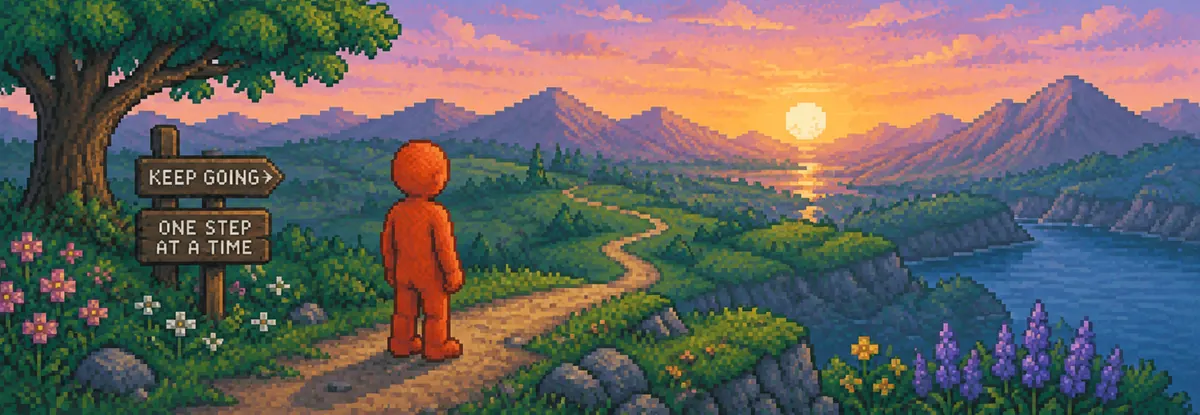
Begin before you are ready
You will probably never feel fully ready. Readiness usually shows up partway through the work.
So pick one small step you could take this week that would teach you something. Write it on a sticky note with a day next to it, and do it on that day. Then look at what it showed you and choose the next one.